
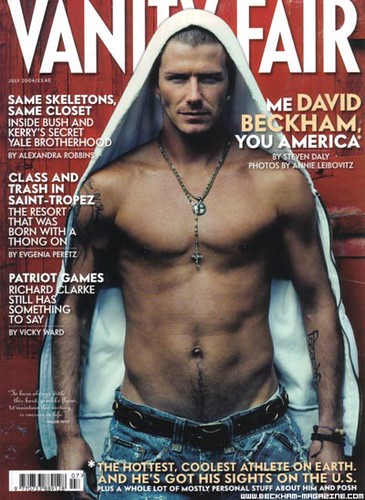
HT takes great pride that we're not a filter blog, but I think everyone needs to see the unhealthy and unholy effect Posh Spice/Victoria Beckham has had on David Beckham:
At the beginning:

7/12/2007
Forbidden Spice -- Beckham on Beckham

 digg
digg reddit
 del.icio.us
The State of the Summer Blockbuster: Transforming Live Free to Die Hard

- Global Hacking of the Communication Infrastructure
- Disruption of the Transportation Grid
- Love For and Fear of the Mechanics of Government
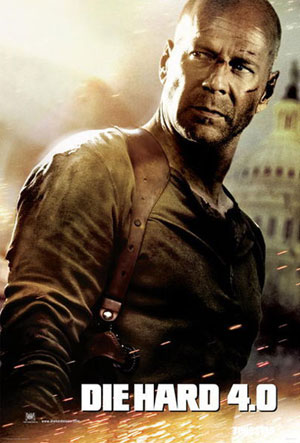 In both films, the enemy (decepticons, an ill-defined french/asian/american coalition of hackers) undermines our communication network and uses that access to attack our heroes (autobots/charmingly dorky teen, bruce willis/charmingly dorky young adult) and deny them communication. In both cases our heroes use a lower tech solution (Morse code, "old military satellite network") to reestablish connections. Die Hard takes this scenario a little farther with the villains using the internet as their method of attack. In both cases we lose our ability to speak without being monitored and our ability to trust what we hear, which seems to reflect the state of communications under the Bush Administration and the Patriot Act.
Secondly, both films have scenes involving the destruction of freeways by fighter pilots, as our heroes (both tractor trailers, oddly, although Optimus Prime *is* the tractor trailer while John McClane is merely driving one). Hacked lights and giant robot attacks create massive gridlock. We can no longer count on getting from one place to another as military jets destroy the homeland's infrastructure. It isn't much of a stretch to view this as a comment on how a protracted war abroad is destroying the basics of life here.
However, both films have a strong yet conflicted element of patriotism that makes such a facile conclusion difficult. In Transformers, all of the evil Decepticons take the form of military and industrial vehicles and yet the only competent heroes are the marines in Qatar who discover the only way to kill the invading robots with our current technology. In Die Hard, I started to sympathize with the cyber-criminals who are trying to make a point about our nation's technological vulnerabilities and the corruption of our current regime. However, the mastermind is then revealed to actually just be after money, and begins to kill his underlings and innocents left and right. It's perfectly summed up in an exchange between Justin Long (Willis' computer-hacking sidekick) and Willis himself.
Justin (paraphrased): I used to think a fire-sale [wholesale takedown of all infrastructure] would be an amazing way to take down the system.
Willis: This isn't a system, it's a country, and we need to protect it.
I believe the filmmakers were just as conflicted as I am. Maybe it's just the July 4th summer blockbusters talking, but I love this country. We have freedoms other countries ignore. We are a leader in technological development. We have integrated diverse people in a way few other nations have or will. But we also have a corrupt government, a military-industrial complex run amok, and a hegemonic media machine attempting to subvert the whole world to our selfish way of life. The situation is complicated and I believe these films attempted to show that as much as they could without sacrificing box office attendance or risking being called un-American.
And if having integrity up until the point it would you hurt fiscally or politically isn't American, than I don't know what is.
[MD: I also think there's a lot to say about the absence of other nations' involvement in both films, and the idea of the enemy within vis a vis immigration but those are essays for another time. And don't get me started on the inevitability of the hetero dyad.]
In both films, the enemy (decepticons, an ill-defined french/asian/american coalition of hackers) undermines our communication network and uses that access to attack our heroes (autobots/charmingly dorky teen, bruce willis/charmingly dorky young adult) and deny them communication. In both cases our heroes use a lower tech solution (Morse code, "old military satellite network") to reestablish connections. Die Hard takes this scenario a little farther with the villains using the internet as their method of attack. In both cases we lose our ability to speak without being monitored and our ability to trust what we hear, which seems to reflect the state of communications under the Bush Administration and the Patriot Act.
Secondly, both films have scenes involving the destruction of freeways by fighter pilots, as our heroes (both tractor trailers, oddly, although Optimus Prime *is* the tractor trailer while John McClane is merely driving one). Hacked lights and giant robot attacks create massive gridlock. We can no longer count on getting from one place to another as military jets destroy the homeland's infrastructure. It isn't much of a stretch to view this as a comment on how a protracted war abroad is destroying the basics of life here.
However, both films have a strong yet conflicted element of patriotism that makes such a facile conclusion difficult. In Transformers, all of the evil Decepticons take the form of military and industrial vehicles and yet the only competent heroes are the marines in Qatar who discover the only way to kill the invading robots with our current technology. In Die Hard, I started to sympathize with the cyber-criminals who are trying to make a point about our nation's technological vulnerabilities and the corruption of our current regime. However, the mastermind is then revealed to actually just be after money, and begins to kill his underlings and innocents left and right. It's perfectly summed up in an exchange between Justin Long (Willis' computer-hacking sidekick) and Willis himself.
Justin (paraphrased): I used to think a fire-sale [wholesale takedown of all infrastructure] would be an amazing way to take down the system.
Willis: This isn't a system, it's a country, and we need to protect it.
I believe the filmmakers were just as conflicted as I am. Maybe it's just the July 4th summer blockbusters talking, but I love this country. We have freedoms other countries ignore. We are a leader in technological development. We have integrated diverse people in a way few other nations have or will. But we also have a corrupt government, a military-industrial complex run amok, and a hegemonic media machine attempting to subvert the whole world to our selfish way of life. The situation is complicated and I believe these films attempted to show that as much as they could without sacrificing box office attendance or risking being called un-American.
And if having integrity up until the point it would you hurt fiscally or politically isn't American, than I don't know what is.
[MD: I also think there's a lot to say about the absence of other nations' involvement in both films, and the idea of the enemy within vis a vis immigration but those are essays for another time. And don't get me started on the inevitability of the hetero dyad.]
Tasty: Momofuku Ssäm Bar
 There's absolutely nothing I could write about Momofuku Ssäm Bar that a bazillion foodies haven't already waxed rhapsodic about. Well, there's one unique thing I could tell you: I finally went there. (Thanks, RZS, for being such a gleeful dining companion.) And it was glorious. You gotta love a place that states very baldly on its menu that its food is not vegetarian friendly. RZS and I decided to go all out: absolutely awesome spicy squid and celery salad was followed by manila clams, grilled pickled baby corn, rice cakes, and chinese sausage and greens in a bacon dashi broth (yeah, you read that right: bacon dashi, my friends). Then a rapturous banh mi sandwich with a terrine of ham, veal headcheese, and chicken-liver paté. And finally, the restaurant's signature Ssäm: an Asian burrito of sorts with shredded Berkshire pork, kimchi, onions, and edamame. By that point I had hit the dreaded wall of food coma. But no matter: consuming pork fat in such innovative and myriad incarnations was totally worth it. I'd tell you that I'm going back for more, but I don't know how long I'll remain completely incapacitated.
[Click on image above for exquisite detail. Oh: if there's any flaw to be noted, it's that the wines by the glass are a touch pricey. Stick with the beer options, methinks.]
There's absolutely nothing I could write about Momofuku Ssäm Bar that a bazillion foodies haven't already waxed rhapsodic about. Well, there's one unique thing I could tell you: I finally went there. (Thanks, RZS, for being such a gleeful dining companion.) And it was glorious. You gotta love a place that states very baldly on its menu that its food is not vegetarian friendly. RZS and I decided to go all out: absolutely awesome spicy squid and celery salad was followed by manila clams, grilled pickled baby corn, rice cakes, and chinese sausage and greens in a bacon dashi broth (yeah, you read that right: bacon dashi, my friends). Then a rapturous banh mi sandwich with a terrine of ham, veal headcheese, and chicken-liver paté. And finally, the restaurant's signature Ssäm: an Asian burrito of sorts with shredded Berkshire pork, kimchi, onions, and edamame. By that point I had hit the dreaded wall of food coma. But no matter: consuming pork fat in such innovative and myriad incarnations was totally worth it. I'd tell you that I'm going back for more, but I don't know how long I'll remain completely incapacitated.
[Click on image above for exquisite detail. Oh: if there's any flaw to be noted, it's that the wines by the glass are a touch pricey. Stick with the beer options, methinks.]
7/11/2007
Photo Week Profile: Jason Oddy
 Other than a few nights in which I've found myself looking intently but defeatedly at the half-empty glass of whiskey in front of me, I've been staring almost exclusively at Jason Oddy's photographs for the past two weeks. GNF first introduced me to his work a couple of years ago, and I had a brief email exchange with him regarding a photograph that I wanted very much to have in my possession. The image was of a rundown Soviet-era sanatorium, taken from inside the window of another sanatorium building; part of an entire series of photographs featured in a 2001 issue of Metropolis documenting Soviet sanatoria now falling into ruin, the photograph grabbed me immediately and fully in its interweaving of textures, colors, content, and elegiac, (false) memory-filled faraway-ness. Although the price tag was way above my then-graduate-student means (even with a friend-of-friend-discount), I haven't stopped dreaming idly about the image, and about Oddy's oeuvre in general. Now that I've found his website, I can't help but continually scroll through the images and sigh pretty much nonstop.
 Oddy's work has taken him inside not only empty Soviet sanatoria, but also the UN headquarters in Geneva, Guantanamo Bay, the Pentagon, even the cluttered, unraveled homes of the recently deceased . Looking through his photographs, one is immediately struck by the absence of people -- of faces, movement, exchange -- of what we might understand or register as life. At the same time, these aren't landscape photos, or even photographs of places.
  Rather, these images compel a direct viewing of these spaces as place, as space constructed by and for humans, for life. And as such, they speak to the ways that space comes together to create, reflect, and perpetuate 'culture' in all the ways we might know and/or experience it. In his site, Oddy writes that "In the photographs .... I have treated architectural space as a cultural artefact, one which not only reflects but which also seeks to create historical reality."
Seen in this way, the photographs feel less cold or removed than they seem stripped down to the basic questions of how space (or rather, the overt, conspicuous configuration of that space) dictates how we interact in those realms.
Rather, these images compel a direct viewing of these spaces as place, as space constructed by and for humans, for life. And as such, they speak to the ways that space comes together to create, reflect, and perpetuate 'culture' in all the ways we might know and/or experience it. In his site, Oddy writes that "In the photographs .... I have treated architectural space as a cultural artefact, one which not only reflects but which also seeks to create historical reality."
Seen in this way, the photographs feel less cold or removed than they seem stripped down to the basic questions of how space (or rather, the overt, conspicuous configuration of that space) dictates how we interact in those realms. And, across different projects, we can see overlaps in design -- how ideologies, regardless of content, similarly seek to impose order on its subjects, most fundamentally through the ways that the spaces they occupy compel specific kinds of interactions and daily exchanges. How ideologies, essentially, prescribe social relations.
I could write about how Oddy's photographs are elegantly minimalist in their composition and colors, or how it just might be the case that he finds those spaces as-is, and simply has an amazing eye for capturing power or order, or its seeming absence, in their starkest, most essential states (and I do believe it's the case that both are true with regard to Oddy's talent). But there's something else at work here, something that makes these photographs entirely Oddy's, but also entirely ours, too .... And I think it has to do with the familiarity of it all, how we can imagine the kinds of relations determined these spatial configurations. How these settings bring power to life -- literally, but also figuratively, in the sense that they call our attention to the potency of architecture itself, and how we need not be in hallowed halls of multinational authority in order to experience the potency of constructed , designed space. The photographs depict, at heart, narratives of power, and how power in turn narrates the past, present, and future, in sometimes overt ways and in other instances through much more subtle channels. How it doesn't have to feel like power in order for you to be caught within it, organized by it. How power doesn't have to be an insidious, evil, demon-like cephalopod, its tentacles reaching everywhere, to nonetheless be present. And how that presence is immediately felt through its architectural manifestations.
To be sure, I'm no Foucauldian, lets-intervene-in-the-ways-that-power-becomes- institutionalized-and-ritualized-in-daily-life sort of acolyte or anything. I don't think Oddy photographed these realms with a mind to present them as an immediate, always-already sort of critique of space and power.
And, across different projects, we can see overlaps in design -- how ideologies, regardless of content, similarly seek to impose order on its subjects, most fundamentally through the ways that the spaces they occupy compel specific kinds of interactions and daily exchanges. How ideologies, essentially, prescribe social relations.
I could write about how Oddy's photographs are elegantly minimalist in their composition and colors, or how it just might be the case that he finds those spaces as-is, and simply has an amazing eye for capturing power or order, or its seeming absence, in their starkest, most essential states (and I do believe it's the case that both are true with regard to Oddy's talent). But there's something else at work here, something that makes these photographs entirely Oddy's, but also entirely ours, too .... And I think it has to do with the familiarity of it all, how we can imagine the kinds of relations determined these spatial configurations. How these settings bring power to life -- literally, but also figuratively, in the sense that they call our attention to the potency of architecture itself, and how we need not be in hallowed halls of multinational authority in order to experience the potency of constructed , designed space. The photographs depict, at heart, narratives of power, and how power in turn narrates the past, present, and future, in sometimes overt ways and in other instances through much more subtle channels. How it doesn't have to feel like power in order for you to be caught within it, organized by it. How power doesn't have to be an insidious, evil, demon-like cephalopod, its tentacles reaching everywhere, to nonetheless be present. And how that presence is immediately felt through its architectural manifestations.
To be sure, I'm no Foucauldian, lets-intervene-in-the-ways-that-power-becomes- institutionalized-and-ritualized-in-daily-life sort of acolyte or anything. I don't think Oddy photographed these realms with a mind to present them as an immediate, always-already sort of critique of space and power.  What is intriguing about Oddy's work is that in spite of its minimal, stark colors and tonal contrasts, there's still this strange nuance, this quiet trace, that one can find in all of these spaces. Their familiarity might have something to do with this feeling that, however removed they are from our own experiences, we can nonetheless sense that lived-in-ness. People become who they are in, through, and by these spaces, for better or for worse.
 I was already deeply in love with Oddy's oeuvre before I read his artist's statement, and well, that's when I nearly lost my shit. Near the end of his statement, Oddy quotes my favorite line from Sebald, the thing* about how grand buildings already speak to their inevitable decay. (I love that line. My dissertation would be nothing without that line.) Oddy then remarks:
"A number of the places I have photographed represent some of mankind's most far-reaching attempts to systematise the world. Yet here as nowhere else we see how all such attempts are inscribed with their own failure. Hubris makes us reach for Utopia. Reality, in the guise of time, sends us back ruins."
Oddy's Waiting Rooms series documents not ruins in the conventional, Roman-Empire-esque sense of the word, but rather the unraveling of architecture over time, an unraveling experienced on an individual level, but a ruin all the same. These spaces are not the endpoint of architecture -- I don't think that Oddy is necessarily suggesting through these photographs that all space comes to the same end, or that it comes to an end at all, or that we should look upon them as the future of, say, the Palace of Nations or the Pentagon. I think, rather, the contrast is between the attempt to systematise and the reality of living, of what it means to inhabit a space: the ruin is not in the decay but rather in the attempt at order itself; the endpoint of Utopia is the return to daily life.
I was already deeply in love with Oddy's oeuvre before I read his artist's statement, and well, that's when I nearly lost my shit. Near the end of his statement, Oddy quotes my favorite line from Sebald, the thing* about how grand buildings already speak to their inevitable decay. (I love that line. My dissertation would be nothing without that line.) Oddy then remarks:
"A number of the places I have photographed represent some of mankind's most far-reaching attempts to systematise the world. Yet here as nowhere else we see how all such attempts are inscribed with their own failure. Hubris makes us reach for Utopia. Reality, in the guise of time, sends us back ruins."
Oddy's Waiting Rooms series documents not ruins in the conventional, Roman-Empire-esque sense of the word, but rather the unraveling of architecture over time, an unraveling experienced on an individual level, but a ruin all the same. These spaces are not the endpoint of architecture -- I don't think that Oddy is necessarily suggesting through these photographs that all space comes to the same end, or that it comes to an end at all, or that we should look upon them as the future of, say, the Palace of Nations or the Pentagon. I think, rather, the contrast is between the attempt to systematise and the reality of living, of what it means to inhabit a space: the ruin is not in the decay but rather in the attempt at order itself; the endpoint of Utopia is the return to daily life.  In the case of the Waiting Rooms series, depicting the cluttered spaces of the recently-deceased, that daily life continues: notice the depressions in the sofa cushions from years of wear, or the knick-knacks on the mantle, no doubt the accumulation of presents, souvenirs, and mementos over a long period. These objects reflect and inform our everyday existence, and become an integral part of what defines, for each of us, 'place.' There is little difference, in that sense then, between the painting of the fighter jet in the Pentagon conference room and the framed collage of photographs perched on the mantle.
What stories do we want our spaces to tell? What kinds of narratives influence, and are then perpetuated by, current architecture and design? Oddy's photographs have got me thinking. A lot. But even more fundamentally, they've got me sighing. And, truth be told, desiring. I mean, these are spectacular photographs. If anyone would like to start a "Get HT That Sanatorium Photograph" fund, I wouldn't stop you. Ahem.
* "...for somehow we know by instinct that outsized buildings cast the shadow of their own destruction before them, and are designed from the first with an eye to their later existence as ruins."
[check out Jason Oddy's work here. Seesaw magazine also did a piece, Seats of Power, compiling his photographs of chairs and sitting areas.]
In the case of the Waiting Rooms series, depicting the cluttered spaces of the recently-deceased, that daily life continues: notice the depressions in the sofa cushions from years of wear, or the knick-knacks on the mantle, no doubt the accumulation of presents, souvenirs, and mementos over a long period. These objects reflect and inform our everyday existence, and become an integral part of what defines, for each of us, 'place.' There is little difference, in that sense then, between the painting of the fighter jet in the Pentagon conference room and the framed collage of photographs perched on the mantle.
What stories do we want our spaces to tell? What kinds of narratives influence, and are then perpetuated by, current architecture and design? Oddy's photographs have got me thinking. A lot. But even more fundamentally, they've got me sighing. And, truth be told, desiring. I mean, these are spectacular photographs. If anyone would like to start a "Get HT That Sanatorium Photograph" fund, I wouldn't stop you. Ahem.
* "...for somehow we know by instinct that outsized buildings cast the shadow of their own destruction before them, and are designed from the first with an eye to their later existence as ruins."
[check out Jason Oddy's work here. Seesaw magazine also did a piece, Seats of Power, compiling his photographs of chairs and sitting areas.]
7/10/2007
Tasty: Super Taste
 I had read in just about very credible major New York foodie site -- Sietsema, Ganda at eatdrinkonewoman, the Cheap Eats folks at New York Magazine , and the boys over at Twenty Bucks a Day -- that Eldredge Street noodle joint Super Taste was the place to be, even if one would look garish and pale under the fluorescent lights whilst trying the hand-pulled noodle bowls. It took me a year, however, to finally get someone to come with me to the Lanzhou/Silk Road-based hole in the wall. Probably for the best: my eventual dining companion, the inestimable IB, is almost always in the mood for weather-inappropriate fare. What's more, IB had been there numerous times already, and had nothing but raves and recommendations for the best bowls of slurpy goodness.
  So on a hot, steamy, very-hot-noodle-unfriendly night we traipsed over to get two bowls of their hot & spicy hand-pulled noodles with beef brisket. At $4.25 a pop. No, I'm not kidding. That cheap.
And, as it turns out, that good. So good. The beef broth was potent -- earthy, beefy, and according to Ganda over at eatdrinkonewoman, laden with MSG (not a problem for me, but just a heads up if you're concerned), but not at all heavy. The noodles were heavenly -- doughy, but not too thick, and the brisket a wonderful mix of about 90% inexplicably tender meat and 10% fat, the latter adding to the depth of the broth. The noodles came out in plastic bowls, accompanied by disposable chopsticks and (this was new to me) plastic, disposable chinese soup spoons. Green-unfriendly-eating aside, I finished my bowl in 10 minutes flat -- and I never finish a bowl of noodles. (Seriously: when I'm home in Los Angeles, I give my pho/noodle leftovers to my kid brother, who will finish off just about anything with gusto and delight.) And for a couple of hours afterwards, I had a hankering for seconds.
So on a hot, steamy, very-hot-noodle-unfriendly night we traipsed over to get two bowls of their hot & spicy hand-pulled noodles with beef brisket. At $4.25 a pop. No, I'm not kidding. That cheap.
And, as it turns out, that good. So good. The beef broth was potent -- earthy, beefy, and according to Ganda over at eatdrinkonewoman, laden with MSG (not a problem for me, but just a heads up if you're concerned), but not at all heavy. The noodles were heavenly -- doughy, but not too thick, and the brisket a wonderful mix of about 90% inexplicably tender meat and 10% fat, the latter adding to the depth of the broth. The noodles came out in plastic bowls, accompanied by disposable chopsticks and (this was new to me) plastic, disposable chinese soup spoons. Green-unfriendly-eating aside, I finished my bowl in 10 minutes flat -- and I never finish a bowl of noodles. (Seriously: when I'm home in Los Angeles, I give my pho/noodle leftovers to my kid brother, who will finish off just about anything with gusto and delight.) And for a couple of hours afterwards, I had a hankering for seconds.
 Instead of seconds, IB and I headed over to Clandestino, where I tried a Pimms Cups (one of their signature drinks) -- the best post-noodle concoction if I ever drank one. Cucumbery, Pimms-y, gingery ... the best way to beat a New York heatwave. But don't get me wrong: I'm going back to Super Taste the first chance I get (they've got an eel option!), weather appropriate or not. And, as always, you're always welcome to join me. At those prices, I'll even buy you dinner.
My Favorite Photos (or: Memory, Ruins, etc.)
 For many years I took photos almost exclusively with an old Nikon FE that my father bequeathed to me once he had upgraded -- or rather, retro-graded -- to his original love, a Pentax K-1000, which had been a replacement for his first Pentax, stolen several years earlier. I still love my Nikon FE. Manufactured in the late 70's/early80s, it's a sturdy SLR, a camera's camera, with proper metal parts and a nice, but not unmanageable, heft. Some of my best photos were taken with that camera, including the one above, of Jimmy and Ian, cousins (to each other -- not me!) who live on the tiny island of Islay, off the western coast of Scotland and home to the best scotch on the planet. One rainy morning, while waiting for the bus in tiny Port Ellen to take me to the island's wee capital, Bowmore, Ian (the bespectacled one) and I struck up a conversation:
Ian: What are you waiting for?
Me: The bus to Bowmore.
Ian. Ah.
Me: What are you waiting for?
Ian: Eleven o'clock.
Me: What happens at eleven?
Ian: [points down the street] Pub opens.
The next thing I knew, Ian had convinced me to take the 12:30 bus and in the meanwhile join him and his cousin Jimmy at the local pub. There, at eleven in the morning, about a dozen men were already sitting at little tables drinking wee glasses of vodka+lemonade. Ian ordered me a whisky. I protested, pointing out that it was, well, before noon. Ian's response: Ah, it'll set you straight for the day!
I haven't been the same person since.
In late November 2005, I received a Panasonic Lumix DMC-FX9 as a dissertation-completion gift from NM and AFN. The gift came as a wonderful surprise, as did its digital-ness -- I had been cautiously avoiding entering into the world of digital photography, partly out of "real film" loyalty, and partly because I honestly had no idea which camera to buy. But, presented with the lovely Lumix -- with a Leica lens, no less -- well, there I suddenly was: nearly technologically at pace with the rest of the world. Finally.
I celebrated by sleeping with an ex who was visiting from out of town, and then accompanying him the next day to Fort Totten, an old, Civil War-era military installation near Bayside, Queens that's still occasionally used by the Army and Coast Guard for training drills. [There's a Fort Totten park that's open to the public, but the base itself is fenced off -- email me if you want info on how to get in.] 18 hours after receiving my first (and only) digital camera, and some 8 hours after rolling out of bed with an ex, I took this photograph:
For many years I took photos almost exclusively with an old Nikon FE that my father bequeathed to me once he had upgraded -- or rather, retro-graded -- to his original love, a Pentax K-1000, which had been a replacement for his first Pentax, stolen several years earlier. I still love my Nikon FE. Manufactured in the late 70's/early80s, it's a sturdy SLR, a camera's camera, with proper metal parts and a nice, but not unmanageable, heft. Some of my best photos were taken with that camera, including the one above, of Jimmy and Ian, cousins (to each other -- not me!) who live on the tiny island of Islay, off the western coast of Scotland and home to the best scotch on the planet. One rainy morning, while waiting for the bus in tiny Port Ellen to take me to the island's wee capital, Bowmore, Ian (the bespectacled one) and I struck up a conversation:
Ian: What are you waiting for?
Me: The bus to Bowmore.
Ian. Ah.
Me: What are you waiting for?
Ian: Eleven o'clock.
Me: What happens at eleven?
Ian: [points down the street] Pub opens.
The next thing I knew, Ian had convinced me to take the 12:30 bus and in the meanwhile join him and his cousin Jimmy at the local pub. There, at eleven in the morning, about a dozen men were already sitting at little tables drinking wee glasses of vodka+lemonade. Ian ordered me a whisky. I protested, pointing out that it was, well, before noon. Ian's response: Ah, it'll set you straight for the day!
I haven't been the same person since.
In late November 2005, I received a Panasonic Lumix DMC-FX9 as a dissertation-completion gift from NM and AFN. The gift came as a wonderful surprise, as did its digital-ness -- I had been cautiously avoiding entering into the world of digital photography, partly out of "real film" loyalty, and partly because I honestly had no idea which camera to buy. But, presented with the lovely Lumix -- with a Leica lens, no less -- well, there I suddenly was: nearly technologically at pace with the rest of the world. Finally.
I celebrated by sleeping with an ex who was visiting from out of town, and then accompanying him the next day to Fort Totten, an old, Civil War-era military installation near Bayside, Queens that's still occasionally used by the Army and Coast Guard for training drills. [There's a Fort Totten park that's open to the public, but the base itself is fenced off -- email me if you want info on how to get in.] 18 hours after receiving my first (and only) digital camera, and some 8 hours after rolling out of bed with an ex, I took this photograph:
 It's probably the best photo I've taken with my Lumix (click on image to enlarge). I'll leave it up to you to make some quip about exes and decay.
It is perhaps no surprise that my favorite two photographs involve whisky and ruins. But in thinking about Photo Week, I realized that what I loved about taking those photos was not simply in the capturing, but also in the possibility of sharing them. I'm trying to avoid some hokey conclusion about photography and community, but I will say that as we seem to get inundated with more -- and faster -- means of collecting and processing information, it's nice to sometimes slow down and just kind of ... stare ... at the image you might have in front of you. The best photographs require you to take them in a bit -- so we here at probably awkward hope that you'll join us in slowing down, sitting back, and taking some time away (er... for the most part) from our usual pomp and snark.
Back to our regularly-scheduled ironic vs. irate cagematch as soon as this heat wave is over.
It's probably the best photo I've taken with my Lumix (click on image to enlarge). I'll leave it up to you to make some quip about exes and decay.
It is perhaps no surprise that my favorite two photographs involve whisky and ruins. But in thinking about Photo Week, I realized that what I loved about taking those photos was not simply in the capturing, but also in the possibility of sharing them. I'm trying to avoid some hokey conclusion about photography and community, but I will say that as we seem to get inundated with more -- and faster -- means of collecting and processing information, it's nice to sometimes slow down and just kind of ... stare ... at the image you might have in front of you. The best photographs require you to take them in a bit -- so we here at probably awkward hope that you'll join us in slowing down, sitting back, and taking some time away (er... for the most part) from our usual pomp and snark.
Back to our regularly-scheduled ironic vs. irate cagematch as soon as this heat wave is over.
7/09/2007
This Week in Awkward: Photo Week
There are many things HT and I have in common: a love of red meat, an appreciation of a good ruin, and a hatred of... well, pretty much everything else. But one thing truly unites us: Both HT and I utterly lack depth perception. Pitching, hitting, catching, horseshoes -- these things are all lost on us. I believe this might be one reason for our love of photography. The world is already flat and out of focus for us, and a camera lets us find the third dimension with a low f-stop and narrow depth of field. Diopters make the world a little less fuzzy. Perhaps most importantly, cameras give us one more excuse to step outside the moment, pin it like a butterfly and analyze it later at our leisure.
This week is devoted to our love of photography and the moving and still image: HT will discuss one of her favorite photographers from a critical theory perspective, and I'll be addressing another camera jockey from my more visceral perspective. Then HT and I will share our favorite image sources on the web and I'll be writing a love letter to my new camera.
Oh, Nikon D40x I love you so.
[ht adds: We've had a soft opening of sorts for a couple of weeks now, but with Photo Week, we'd like to officially introduce you to our Picasa slideshow (situated on the sidebar to the right). It's got photos of just about everything we've seen/eaten/smirked at since we started the blog. Enjoy!]
Consumer Folly: I'm With the Band
 Threadless just announced that this t-shirt was going on sale. I'll admit to being smirkily charmed by the design at first, until it occurred to me that it would end up on all the wrong people.
You know, people who actually believe it.
[md: I saw this earlier and thought it said "I listen to brands that don't even exist yet." I totally almost bought it. Thank G-d I waited.]
[update: KS just alerted me to the fact that it's the tagline for an actual website. Good lord.]
Threadless just announced that this t-shirt was going on sale. I'll admit to being smirkily charmed by the design at first, until it occurred to me that it would end up on all the wrong people.
You know, people who actually believe it.
[md: I saw this earlier and thought it said "I listen to brands that don't even exist yet." I totally almost bought it. Thank G-d I waited.]
[update: KS just alerted me to the fact that it's the tagline for an actual website. Good lord.]
The Quirk: Shushing You Into Submission
I know a handful of librarians, and they're awesome. When they're not librarying, they make art and music, partake in the consumption of great food, and will occasionally deep-fry a turkey just for the hell of it. My librarian friends are also a pretty attractive lot. They do not, however, look like this (nor do they sit atop anything in that manner),
 and I feel the world is a better place for it.
[NY Times: A Hipper Crowd of Shushers]
and I feel the world is a better place for it.
[NY Times: A Hipper Crowd of Shushers]
7/08/2007
Early Sunday Morning Rhapsodic: Saturday at the Farm
 On Saturday morning, RP and I went down with MH to his family's mostly-non-working farm situated some 30 minutes north of Princeton, NJ. Along the way, we stopped at a grocery store to get some seafood, and then purchased amazing Jersey sweetcorn from a pickup truck parked by the side of the road. At the farm, we lounged in inflatable floaty donut things inside the pool, played bocce and horseshoes (see above!), napped, chilled out with a lively 22-month-old wunderkind, grilled the seafood and corn, and just generally had a low-key, perfect Saturday afternoon, seemingly a gazillion miles away from the city. Somewhere in there I even very gamely tried my first egg salad sandwich (do not get me started on my long-standing fear of mayonnaise). Maybe it was because of the day in general, but man, that was tasty.
The three of us had had something of a bender-y Friday, and so before we set off for Jersey, I steered us towards a nearby McDonalds. (I know, I know. I'm a terrible person.) There, McMuffin sandwiches were consumed with reckless abandon -- or at least as reckless and abandon-filled as three hungover people can muster at 10 on a Saturday morning in Chelsea. It gave us the necessary energy to start the trip, such that afterwards I felt compelled to proclaim, "I believe in hand-held sausage!"
Oh yeah. Mild sunburn aside, I'm going to sleep very well tonight. Back to ironic, detached judgment tomorrow.
On Saturday morning, RP and I went down with MH to his family's mostly-non-working farm situated some 30 minutes north of Princeton, NJ. Along the way, we stopped at a grocery store to get some seafood, and then purchased amazing Jersey sweetcorn from a pickup truck parked by the side of the road. At the farm, we lounged in inflatable floaty donut things inside the pool, played bocce and horseshoes (see above!), napped, chilled out with a lively 22-month-old wunderkind, grilled the seafood and corn, and just generally had a low-key, perfect Saturday afternoon, seemingly a gazillion miles away from the city. Somewhere in there I even very gamely tried my first egg salad sandwich (do not get me started on my long-standing fear of mayonnaise). Maybe it was because of the day in general, but man, that was tasty.
The three of us had had something of a bender-y Friday, and so before we set off for Jersey, I steered us towards a nearby McDonalds. (I know, I know. I'm a terrible person.) There, McMuffin sandwiches were consumed with reckless abandon -- or at least as reckless and abandon-filled as three hungover people can muster at 10 on a Saturday morning in Chelsea. It gave us the necessary energy to start the trip, such that afterwards I felt compelled to proclaim, "I believe in hand-held sausage!"
Oh yeah. Mild sunburn aside, I'm going to sleep very well tonight. Back to ironic, detached judgment tomorrow.
7/06/2007
Clearly I'm Not Your Target Audience: The BMW x3
 This is the new BMW x3. It is not an SUV. It is an SAV -- a Sports Activity Vehicle®. It is BMW's luxury crossover sports [whatever-ity] vehicle. It has a base price of $38,000. According to Edmunds, "If you're shopping for a premium, performance-oriented compact SUV -- and don't mind the stiff ride and even stiffer price of entry -- we recommend that you put the BMW X3 at the top of your short list of choices." I do not have such a short list, much less choices. It would be nice to be (independently) wealthy. Choices must be fun.
If I were financially solvent and suddenly confettied with choices, I would not purchase the BMW x3, not simply because I think it's ridiculous to own (and presumably drive) an
This is the new BMW x3. It is not an SUV. It is an SAV -- a Sports Activity Vehicle®. It is BMW's luxury crossover sports [whatever-ity] vehicle. It has a base price of $38,000. According to Edmunds, "If you're shopping for a premium, performance-oriented compact SUV -- and don't mind the stiff ride and even stiffer price of entry -- we recommend that you put the BMW X3 at the top of your short list of choices." I do not have such a short list, much less choices. It would be nice to be (independently) wealthy. Choices must be fun.
If I were financially solvent and suddenly confettied with choices, I would not purchase the BMW x3, not simply because I think it's ridiculous to own (and presumably drive) an SUV SAV in the city, but now also because of this:
 or this:
 I will not deny that these are beautiful images. I almost applaud the agency responsible for these print ads, for reminding people that maybe they should take their SAV to slightly more terrain-appropriate parts of the world. I'm rather appalled, however, by the idea that one with an SAV (or any vehicle) would regard city streets as one's playground (a playground which apparently needs mixing up! Like a fun martini! Whee!). I'm also pretty sure that no one with a $40k SAV is going to be taking it to the desert ... or Peru? (I honestly can't tell where that's supposed to be, intermingled with London.) People with choices find much more clever (and local-economy-exploiting) ways to travel these days.
Reviewing the Previews: Scion's Little Deviants
I am often unable to truly enjoy movies because something offends me during the previews and I get distracted writing angry screeds in my head, and before I know it I've almost missed the opening credits (usually the best part of any film).
So when HT and I decided to get to Live Free or Die Hard early so we can get a good seat, I know we're in for trouble. HT, meanwhile, is excited to catch "The Twenty." I don't have the heart to tell her that's only in Loews and we're in a Regal. [MD: Research has just proven me wrong, it is in fact only shown in Regals with digital projectors. Also, its proper name is "The 2wenty."]
After watching a little animated Lego man run around Mars, we're treated to a commercial featuring animated grey "Sheeple" walking around a depressing urban landscape... suddenly, down from windows, up from the sewers, and out of the alleyways spill these tiny monstrous trolls, "the little deviants." At first, I assume it's an outgrowth of SanDisk's (largely unsuccessful) iSheep campaign,

7/05/2007
We Trash It Before We Try It: Summer 2007 Edition
 This was supposed to be a team post about how we were deeply unenthusiastic about the new Transformers movie: based on the trailers, it looks visually messy (it's a Michael Bay film after all) and more importantly, for a film that's supposed to hearken back to this great animated series and those action figures from our childhood -- there's absolutely nothing iconic about these reimagined Transformers. Nothing. I can't even get excited about new It boy (and the film's 'human' lead) Shia LaBeouf, and he's supposed to be the friggin shiznit.
But then we realized that there are so many things we enjoy dissing without even deigning to try the goods beforehand. And that seemed like an infinitely more entertaining post to write. So for you, now -- an ongoing list of that which we cannot be bothered to bother with.
* Transformers 2007
* Leggings
* Any of the films for which trailers were shown before the July 4th screening of Live Free or Die Hard, minus the one for the full-length Simpsons movie. Also, that Stardust movie (with DeNiro?!!) looks terrible.
* the iPhone (md: i can't have it, therefore i refuse to believe it could be good)
* Amy Winehouse (ht: you can't make me like her! md: she grows on you!)
* The resurgence of 70s hair and 80s fashion (md: tie-dye? seriously, tie-dye?)
* Fette Sau
* Pinkberry (ht: I'm just bitching about the lines, really. I hate lines. And people. God, I bet Miranda July goes there. It's called Pinkberry.)
* Anything going on at the McCarren Pool this summer (cf. Pinkberry. md: except the renegade craft fair, which we arguably did try. ht: and look how well that turned out.)
* Men with handkerchiefs around their necks
* Feist (md: you can't make me like her! ht: she and i have mutual friends! my loyalties are divided!)
* Pirate Master (ht: huh?? people actually auditioned for this?)
* artificial scarcity (ht, to md: wait. haven't you tried it? weren't you victim of it recently? md: oh. these are things we HAVEN'T tried. i forgot!)
[image via transformers wiki page.]
This was supposed to be a team post about how we were deeply unenthusiastic about the new Transformers movie: based on the trailers, it looks visually messy (it's a Michael Bay film after all) and more importantly, for a film that's supposed to hearken back to this great animated series and those action figures from our childhood -- there's absolutely nothing iconic about these reimagined Transformers. Nothing. I can't even get excited about new It boy (and the film's 'human' lead) Shia LaBeouf, and he's supposed to be the friggin shiznit.
But then we realized that there are so many things we enjoy dissing without even deigning to try the goods beforehand. And that seemed like an infinitely more entertaining post to write. So for you, now -- an ongoing list of that which we cannot be bothered to bother with.
* Transformers 2007
* Leggings
* Any of the films for which trailers were shown before the July 4th screening of Live Free or Die Hard, minus the one for the full-length Simpsons movie. Also, that Stardust movie (with DeNiro?!!) looks terrible.
* the iPhone (md: i can't have it, therefore i refuse to believe it could be good)
* Amy Winehouse (ht: you can't make me like her! md: she grows on you!)
* The resurgence of 70s hair and 80s fashion (md: tie-dye? seriously, tie-dye?)
* Fette Sau
* Pinkberry (ht: I'm just bitching about the lines, really. I hate lines. And people. God, I bet Miranda July goes there. It's called Pinkberry.)
* Anything going on at the McCarren Pool this summer (cf. Pinkberry. md: except the renegade craft fair, which we arguably did try. ht: and look how well that turned out.)
* Men with handkerchiefs around their necks
* Feist (md: you can't make me like her! ht: she and i have mutual friends! my loyalties are divided!)
* Pirate Master (ht: huh?? people actually auditioned for this?)
* artificial scarcity (ht, to md: wait. haven't you tried it? weren't you victim of it recently? md: oh. these are things we HAVEN'T tried. i forgot!)
[image via transformers wiki page.]
7/04/2007
Hearsay: Other People's Awkwardness
 When we started this blog, our intention was not necessarily to document only instances of the awkward -- though we're certainly no strangers to it (we're like awkward magnets, really). But now that a good chunk of our readership includes our friends, it has become a bit difficult to tell a good awkward story without appearing to also make fun of said friends. Aliases only get you so far; our readers are pretty astute. So, dear readers, a lot of moments that were probably awkward are going to remain un-blogged, until we can find some way to ensure that the more awkward we get, the likelihood of losing friends and readers drops to zero.
That said, I'm perfectly content with -- and ethically unfazed by -- the idea of talking about other people's encounters with the awkward. In this installment: a couple of mini-vignettes recounting the morning after. I encourage you, dear readers, to send in your own (or others'!) anecdotes.
PC and I were talking about unfortunate mornings of waking up, hungover, and suddenly realizing/remembering that there's someone in bed with you. And immediately panicking. The beauty of the morning after story is that it doesn't really matter how you got there. You're just suddenly there. Without any clothes on. The handful of times this has happened to me, I usually hope that there's a glass of water nearby; more often than not, I am wont to believe that when all else fails, drinking a tall glass of water will make the awkward go away. Or at least make it more explicable. Never works.
PC: "I woke up, and she was laying there, awake, smiling at me. And then, very loudly, she started talking about Sex and the City. And how the writing was really amazing. I mean, Sex and the Fucking City? Really? All I could think was: what have I done?"
The way TL tells the story, the only things you need to know for set-up is: he was drunk. He met a girl. "...And you know that Salvador Dali print, the one that certain people have in their dorm rooms because they think it's really trippy and cool, the one with the melting clocks? Yeah. I woke up and saw that on the wall above her bed, and the only thought I had was: Oh. No."
When we started this blog, our intention was not necessarily to document only instances of the awkward -- though we're certainly no strangers to it (we're like awkward magnets, really). But now that a good chunk of our readership includes our friends, it has become a bit difficult to tell a good awkward story without appearing to also make fun of said friends. Aliases only get you so far; our readers are pretty astute. So, dear readers, a lot of moments that were probably awkward are going to remain un-blogged, until we can find some way to ensure that the more awkward we get, the likelihood of losing friends and readers drops to zero.
That said, I'm perfectly content with -- and ethically unfazed by -- the idea of talking about other people's encounters with the awkward. In this installment: a couple of mini-vignettes recounting the morning after. I encourage you, dear readers, to send in your own (or others'!) anecdotes.
PC and I were talking about unfortunate mornings of waking up, hungover, and suddenly realizing/remembering that there's someone in bed with you. And immediately panicking. The beauty of the morning after story is that it doesn't really matter how you got there. You're just suddenly there. Without any clothes on. The handful of times this has happened to me, I usually hope that there's a glass of water nearby; more often than not, I am wont to believe that when all else fails, drinking a tall glass of water will make the awkward go away. Or at least make it more explicable. Never works.
PC: "I woke up, and she was laying there, awake, smiling at me. And then, very loudly, she started talking about Sex and the City. And how the writing was really amazing. I mean, Sex and the Fucking City? Really? All I could think was: what have I done?"
The way TL tells the story, the only things you need to know for set-up is: he was drunk. He met a girl. "...And you know that Salvador Dali print, the one that certain people have in their dorm rooms because they think it's really trippy and cool, the one with the melting clocks? Yeah. I woke up and saw that on the wall above her bed, and the only thought I had was: Oh. No."
7/03/2007
Tuesday Evening Rhapsodic: Ratatouille
 Over dinner the other night I mentioned my desire to see Ratatouille, the new animated film from Pixar and Brad Bird, the genius behind Iron Giant and The Incredibles. I pointed out that A.O Scott had nothing but raves, including the most-likely-oft-quoted "a nearly flawless piece of popular art." My dinner companions bristled at this, noting that: "The last time A.O. Scott waxed rhapsodic we ended up watching Miami Vice. We won't make the same mistake."
I ended up seeing Ratatouille anyway, at the Ziegfeld no less!, and I have to say: OH MY WORD. It's a great film, full of hilarious physical comedy and foodie-ready good times. (After I saw the rat-protagonist make an omelet, I nearly fainted -- it was that realistic and gut-growl-inducing.) That's all I have to say. You all should go see it soon. Or invite me to see it with you. Whichever. You''ll love it.
Over dinner the other night I mentioned my desire to see Ratatouille, the new animated film from Pixar and Brad Bird, the genius behind Iron Giant and The Incredibles. I pointed out that A.O Scott had nothing but raves, including the most-likely-oft-quoted "a nearly flawless piece of popular art." My dinner companions bristled at this, noting that: "The last time A.O. Scott waxed rhapsodic we ended up watching Miami Vice. We won't make the same mistake."
I ended up seeing Ratatouille anyway, at the Ziegfeld no less!, and I have to say: OH MY WORD. It's a great film, full of hilarious physical comedy and foodie-ready good times. (After I saw the rat-protagonist make an omelet, I nearly fainted -- it was that realistic and gut-growl-inducing.) That's all I have to say. You all should go see it soon. Or invite me to see it with you. Whichever. You''ll love it.
Tuesday Morning Scolding: Internet Explorer? Really?
Our Sitemeter account allows us to see not only how many people have been checking out the blog, but also, somewhat creepily, what operating system they're on, their monitor resolution (no joke!), and what web browser they use. This is a pie chart detailing browser share:
 Before I proceed I'll quickly point out that MD (currently still away on the west coast) is the techie in this blogging pair; I have a sub-layman level of understanding of computers and things like RAM and XML. That said, I'm a little confused as to why 44% of our readers are still using some form of Internet Explorer. (And also: what's Konqueror?!) Unless you've got a Mac and use Safari, there's really no reason why you shouldn't be looking at this blog right now on Firefox. Seriously. So much better. Get on that, people. I expect to see a radically different pie chart by week's end.
7/02/2007
You Can't Fight The Invisible Hand...
...Especially when it takes the form of a cephalopod hologram with creepy, lechy tentacles, playing a central role in the recent Diesel runway show in Florence.
 I give up.
Collective, Unconscious: Ruins, So Very Tragique
 We -- and I speak here for what I can claim to understand, which broadly speaking is "western society" -- are a narcissistic, self-aggrandizing lot. We believe not only in progress, but also in our inherent ability to make it. Moreover, we approach and explain instances of decline with a scientific and analytic (im)precision that cannot help but contain slightly paternalistic moralizing: oh you crazy, pillaging, marauding barbarians, what were you thinking?! In stern, Stone Phillips-y voices laden with gravitas we scold ourselves when confronted with harbingers of future catastrophe, but in the same instance grandly proclaim We Can Change The Present Course of History Because Our Serious Tone Suggests Knowledge and Insight And Maybe Also Condescension Because Even Though We Caused This Mess We're Still Better Than Our Predecessors Because They Surely Must Have Pre-Caused This Mess And At Least We're Trying To Fix It And While We're Fixing It Let's Also Make Some Fun Blockbuster Movies About It So As To Transform Those Harbingers Into Easy Cash Cows.
 So when both 3 Quarks Daily and Gothamist made mention of a recent article in Scientific American entitled An Earth Without People, I couldn't help but be curious and also a little wary. The article is partly an interview with science writer and professor Alan Weisman, who recently published The World Without Us, a book that examines what sorts of things would happen to the planet if humans suddenly disappeared, alien abduction-like, from the face of the earth.* Without regular maintenance, streets and highways would buckle within a couple of months; houses and office buildings would collapse within several decades. And: "Certain common plastics might remain intact for hundreds of thousands of years; they would not break down until microbes evolved the ability to consume them." Crazy!
 As a bonus, for NYC-based readers, you might be interested in looking at the "Fall of New York City" timeline featured in the article; it's got some pretty fascinating facts and images of a suddenly-humanless Manhattan, including flooded subways (2 days), the collapse of the Brooklyn Bridge roadway (300 years from now), and my favorite, 5 billion years down the road: "The earth vaporizes as the dying sun expands and consumes all the inner planets." Whee!
The article was an interesting read overall, and Weisman's intent with the book is, ultimately, pro-environmental in nature, as it attempts to lay out what sorts of toxins, pollutants, and radioactivity we are (and would be) leaving behind -- though he's got a funny way of getting us to think about any of this to begin with:
"What I’m finding is that this way of looking at our planet—by theoretically just removing us—turns out to be so fascinating that it kind of disarms people’s fears or the terrible wave of depression that can engulf us when we read about the environmental problems that we have created and the possible disasters we may be facing in the future. Because frankly, whenever we read about those things, our concern is: Oh, my God, are we going to die? Is this going to be the end? My book eliminates that concern right at the beginning by saying the end has already taken place. For whatever reason, human beings are gone, and now we get to sit back and see what happens in our absence. It’s a delicious little way of reducing all the fear and anxiety. And looking at what would happen in our absence is another way of looking at, well, what goes on in our presence."
As a bonus, for NYC-based readers, you might be interested in looking at the "Fall of New York City" timeline featured in the article; it's got some pretty fascinating facts and images of a suddenly-humanless Manhattan, including flooded subways (2 days), the collapse of the Brooklyn Bridge roadway (300 years from now), and my favorite, 5 billion years down the road: "The earth vaporizes as the dying sun expands and consumes all the inner planets." Whee!
The article was an interesting read overall, and Weisman's intent with the book is, ultimately, pro-environmental in nature, as it attempts to lay out what sorts of toxins, pollutants, and radioactivity we are (and would be) leaving behind -- though he's got a funny way of getting us to think about any of this to begin with:
"What I’m finding is that this way of looking at our planet—by theoretically just removing us—turns out to be so fascinating that it kind of disarms people’s fears or the terrible wave of depression that can engulf us when we read about the environmental problems that we have created and the possible disasters we may be facing in the future. Because frankly, whenever we read about those things, our concern is: Oh, my God, are we going to die? Is this going to be the end? My book eliminates that concern right at the beginning by saying the end has already taken place. For whatever reason, human beings are gone, and now we get to sit back and see what happens in our absence. It’s a delicious little way of reducing all the fear and anxiety. And looking at what would happen in our absence is another way of looking at, well, what goes on in our presence."
 It's an interesting premise: eliminate how we die to discuss what we leave behind. I probably wouldn't describe anything I do as a "delicious little way" of doing anything, but that's just me. I don't have any fundamental issues with Weisman or the article, though the topic of abandoned landscapes did remind me of something I had first seen in bldg blog: Gunkanjima Island. It's a tiny island off the western coast of Japan that had been just an overgrown reef, until folks found coal deposits in the early 19th century, and subsequently began to migrate to the island to start a small coal mining industry.
"Befor [sic] long, the reef had grown into an artificial island of one kilometer (three quarters of a mile) in perimeter, with a population of 5300. Looming above the ocean, it appeared a concrete labyrinth of many-storied apartment houses and mining structures built closely together. Seen from the ocean, the silhouette of the island closely resembled a battleship -- so the island came to be called Gunkanjima, or Battleship Island."
It's an interesting premise: eliminate how we die to discuss what we leave behind. I probably wouldn't describe anything I do as a "delicious little way" of doing anything, but that's just me. I don't have any fundamental issues with Weisman or the article, though the topic of abandoned landscapes did remind me of something I had first seen in bldg blog: Gunkanjima Island. It's a tiny island off the western coast of Japan that had been just an overgrown reef, until folks found coal deposits in the early 19th century, and subsequently began to migrate to the island to start a small coal mining industry.
"Befor [sic] long, the reef had grown into an artificial island of one kilometer (three quarters of a mile) in perimeter, with a population of 5300. Looming above the ocean, it appeared a concrete labyrinth of many-storied apartment houses and mining structures built closely together. Seen from the ocean, the silhouette of the island closely resembled a battleship -- so the island came to be called Gunkanjima, or Battleship Island."
 By the turn of the century, Mitsubishi had purchased the island, and established a long-term project to tap the coal resources from below the sea bottom. The coal mines eventually closed down in 1974 following a gradual shift from coal to petroleum as the central component of the country's energy policy, and by April of that year, all of the island's (human) inhabitants had departed, leaving behind "the empty shell of a city." A Japanese photographer documented the last days of the (inhabited) island, and then returned ten years later to see what had happened to the the buildings and surrounding mining structures. The photographs are visually stunning, and as documents of life, and then of absence, they offer a different way of thinking about ruins.
  That is, we might possibly read ruins not necessarily as sublime, romanticised relics of a time long gone and through (and for) which we now express nostalgic longings for the past, but rather the depiction of a more recent past -- in this case, the end of an island's sole industry and reason for human habitation -- as the catalyst of a process we would otherwise never see: the extent to which our absence from those spaces makes apparent just how much we rely on industry to govern when, where, and how we come together as a collective, and how quickly that collective can dissipate once market forces dictate otherwise. The complete departure of the island's inhabitants was precipitated by the decline of the mining industry on the island, but with the collapse of that market, the local economic infrastructure could no longer be sustained -- and with that, the end of the Gunkajima.
 To be sure, there are other instances and experiences of abandoned cities -- Chernobyl comes to mind here (Robert Polidori's photographs of the city and neighboring Pripyat are quite poignant, as are these from bldg blog) -- collectivities and local economies wiped out by larger forces, natural or otherwise. But, unlike the ruins of the Roman Empire, which we look upon with tragic awe and, more often than not, a moralistic stance against the decadence and power grabs that, if the narrative is to be believed, caused its downfall and its unfolding in the present as beautiful decay, the ruins of Gunkanjima speak to a more immediate unfolding of corporate bottom lines masquerading as national priorities -- decadence, sure, but the recent-pastness of it all makes the ruination more acutely felt, less able to be abstracted into an experience of the sublime. Somehow though, in the collective imagination, a ruin is a ruin is a ruin: at the end of the day, it's all decay.
There's a great line in Sebald's Austerlitz: "...for somehow we know by instinct that outsized buildings cast the shadow of their own destruction before them, and are designed from the first with an eye to their later existence as ruins." This speaks in one sense quite directly to Albert Speer's plans for a re-imagined Berlin under a victorious Third Reich, such that all new buildings should be designed with an eye to their potential as aesthetically pleasing ruins a thousand years later -- his theory of 'ruin value' that I'm pretty sure hasn't been entirely abandoned today. But in another way, buildings need not be outsized or monumental for there to be the potential for ruination. All good things (and bad ones) must come to an end; the problem is that we like to fetishize what that end looks like, reify that moment into an image of a ruin, without wanting to really look at the unravelling that got us there. In other words, it seems that we're willing to look at ruins without really, truly looking at decline; in the same way that one tends to gloss over the fighting that leads to the end of a relationship and instead monumentalize (ruin-ize) that moment we call The Breakup, in privileging ruins we choose to see an aesthetically appealing moment in a narrative we would otherwise like to forget.
To be sure, there are other instances and experiences of abandoned cities -- Chernobyl comes to mind here (Robert Polidori's photographs of the city and neighboring Pripyat are quite poignant, as are these from bldg blog) -- collectivities and local economies wiped out by larger forces, natural or otherwise. But, unlike the ruins of the Roman Empire, which we look upon with tragic awe and, more often than not, a moralistic stance against the decadence and power grabs that, if the narrative is to be believed, caused its downfall and its unfolding in the present as beautiful decay, the ruins of Gunkanjima speak to a more immediate unfolding of corporate bottom lines masquerading as national priorities -- decadence, sure, but the recent-pastness of it all makes the ruination more acutely felt, less able to be abstracted into an experience of the sublime. Somehow though, in the collective imagination, a ruin is a ruin is a ruin: at the end of the day, it's all decay.
There's a great line in Sebald's Austerlitz: "...for somehow we know by instinct that outsized buildings cast the shadow of their own destruction before them, and are designed from the first with an eye to their later existence as ruins." This speaks in one sense quite directly to Albert Speer's plans for a re-imagined Berlin under a victorious Third Reich, such that all new buildings should be designed with an eye to their potential as aesthetically pleasing ruins a thousand years later -- his theory of 'ruin value' that I'm pretty sure hasn't been entirely abandoned today. But in another way, buildings need not be outsized or monumental for there to be the potential for ruination. All good things (and bad ones) must come to an end; the problem is that we like to fetishize what that end looks like, reify that moment into an image of a ruin, without wanting to really look at the unravelling that got us there. In other words, it seems that we're willing to look at ruins without really, truly looking at decline; in the same way that one tends to gloss over the fighting that leads to the end of a relationship and instead monumentalize (ruin-ize) that moment we call The Breakup, in privileging ruins we choose to see an aesthetically appealing moment in a narrative we would otherwise like to forget.
 The beauty of thinking about a world without humans -- and skipping over the part about our sudden disappearance -- is that we're ultimately also able then to gloss over what it might truly mean to be a civilization in decline. Don't get me wrong: I'm all for understanding, and assuming responsibility for, my role in, say, global warming and perpetuating general environmental mayhem; it's not like I want humanity to be in a state of decline. But at the same time, it seems that we need to think about decline in more rigorous ways, and not simply as a necessary binary to progress. It becomes a sort of mythical beast, a Decline Monster that must be vanquished if progress is to march forward -- and as such, the monster is never truly real, never really confronted. It's all just sort of make-believe -- like progress itself.
 The thing with images of actual ruin, then, is that we can either confront the decline and decay that they depict as image, as something with potential aesthetic value (I'm certainly not above thinking that the photographs in these post are, in fact, beautiful) -- or we can think about how the traces of a now-absent collective might (or should) speak to what sorts of structural change need to happen, in order for the paradigm to shift from mythologized progress/decline to real sustainability. We can't avoid ruins, now or in the future; but if we can confront what it might look like to be in a state of decline, I suspect we might also then be able to then find ways to not so much want, need, or produce more (-- and monuments speak to this problem), but rather to want, need, and produce better.
[Photographs in this post are taken from Saiga's website about Gunkanjima Island. There is also a piece in a 2002 issue of Cabinet Magazine that details some of the history of the island, for those who might want to read further.]
[*And yes, I know about, and am planning to see, that ridiculous-looking Will Smith film, I Am Legend, about the last man on Earth. I'm a sucker for the apocalypse.]
The thing with images of actual ruin, then, is that we can either confront the decline and decay that they depict as image, as something with potential aesthetic value (I'm certainly not above thinking that the photographs in these post are, in fact, beautiful) -- or we can think about how the traces of a now-absent collective might (or should) speak to what sorts of structural change need to happen, in order for the paradigm to shift from mythologized progress/decline to real sustainability. We can't avoid ruins, now or in the future; but if we can confront what it might look like to be in a state of decline, I suspect we might also then be able to then find ways to not so much want, need, or produce more (-- and monuments speak to this problem), but rather to want, need, and produce better.
[Photographs in this post are taken from Saiga's website about Gunkanjima Island. There is also a piece in a 2002 issue of Cabinet Magazine that details some of the history of the island, for those who might want to read further.]
[*And yes, I know about, and am planning to see, that ridiculous-looking Will Smith film, I Am Legend, about the last man on Earth. I'm a sucker for the apocalypse.]
7/01/2007
Better Than That Fancy Brunch You're About to Have
 I cannot wax rhapsodic enough about the wonders of having one's first (and potentially only) meal of the day at the Red Hook ballfields. J.Slab over at Porkchop Express is much more thorough in his coverage (he's got individual reviews of each of the vendors, plus a handy map), so I'll just post a couple of photos from my sojourn yesterday with RZS -- click on any image to enlarge. We (along with his pals ECM and TF) skipped over the mammoth, coma-inducing huarache/quesadilla options, and stuck to smaller plates, sharing bites of each other's plates. A much better plan if one wants to 1. try a broader range of vendors' options, and 2. live to see the end of the day.
 We tried tacos from both the Martinez and Hernandez stands (bisteck and enchilada -- spiced pork -- tacos from each vendor), and finished them so quickly that I didn't get a chance to get a photo of the taco-sharing frenzy. (The Hernandez tacos won out in both bisteck and enchilada categories; their pork's got some nice texture and kick to it.) There was also a chicharones plate, which was something of a mistake -- fried pork rinds aren't exactly the best palate cleanser; that was followed by a lovely loroco flower & cheese pupusa, from the Lainez family stand (if you get that pupusa, ask nicely if they'll add jalapenos to it).
 The day's winner, however, was the Rojas Ecuadorian stand, which featured a spectacular mixed-seafood ceviche and a deeply satisfying meat empanada (and a fiery hot sauce -- you are forewarned!). The ceviche had a refreshing mix of lime, onion, and coconut milk, with loads of semi-raw seafood -- fish, calamari, octopus, and shrimp. An amazing way to start our Red Hook day. RZS decided to end the afternoon with one of their empanadas, which contained meat, hard boiled egg, and peppers -- so very, very good.
 What to do when you've had probably the best meal (and best two hours) of your day, and it's only 3 in the afternoon? Drinks at Brooklyn Inn and then hours of lazy Swedish lawn game-playing in Prospect Park, of course. Anyone who would like to partake in such a summer Saturday should contact me at their earliest convenience. I guarantee it'll be cheaper and more satisfying than those boring and overpriced eggs benedict you're about to consume.
No One Belongs Here More Than Me, and Certainly Not You
 I jest. But yes, in case anyone was wondering, I have in fact seen and read the Sunday Times' Book Review piece on the new Miranda July collection of short stories. I can't properly comment on the review or the book, as I do not possess a copy of said work. If anyone would like to lend me their copy, please write to us here at probablyawkward [at] gmail [dot ] com. No, seriously: If you lend it to me, I'll totally read it. My ongoing grumble-grumble about the quirk does not preempt my fundamental belief that one ought to, you know, read the book before one can sigh deeply and take the naïf to task.
[above: the image on the opening page of the website for the book. no, i'm not kidding.]
I jest. But yes, in case anyone was wondering, I have in fact seen and read the Sunday Times' Book Review piece on the new Miranda July collection of short stories. I can't properly comment on the review or the book, as I do not possess a copy of said work. If anyone would like to lend me their copy, please write to us here at probablyawkward [at] gmail [dot ] com. No, seriously: If you lend it to me, I'll totally read it. My ongoing grumble-grumble about the quirk does not preempt my fundamental belief that one ought to, you know, read the book before one can sigh deeply and take the naïf to task.
[above: the image on the opening page of the website for the book. no, i'm not kidding.]
6/29/2007
The Office Pool
 About six or seven weeks ago, when it looked like maybe, just maybe, Alberto Gonzales would be forced to resign from his post as Attorney General, KPC started a little office pool: when would he be Gone-zales?
 So people placed bets by writing down dates, and then scotch-taping quarters and a lone dollar bill to a sheet of legal pad paper. The winner would get a grand total of $3.88 (we work at an underpaying non-profit). My guess: sadly, May 24th. (I was feeling particularly optimistic.) Predictions ranged from late May to Election Day 2008. An X marks a date guessed and passed, a moment of hope come and gone. What started as a fun convergence of office camaraderie and a seeming sure thing has now become a monument to an administration's amazing ability to ignore public sentiment and Reason altogether. (White) House always wins, I guess.
[addendum: Also pinned to the wall -- the deeply entertaining Moustache of Understanding.]
So people placed bets by writing down dates, and then scotch-taping quarters and a lone dollar bill to a sheet of legal pad paper. The winner would get a grand total of $3.88 (we work at an underpaying non-profit). My guess: sadly, May 24th. (I was feeling particularly optimistic.) Predictions ranged from late May to Election Day 2008. An X marks a date guessed and passed, a moment of hope come and gone. What started as a fun convergence of office camaraderie and a seeming sure thing has now become a monument to an administration's amazing ability to ignore public sentiment and Reason altogether. (White) House always wins, I guess.
[addendum: Also pinned to the wall -- the deeply entertaining Moustache of Understanding.]

6/28/2007
I Drink Alone So You Don't Have To: Clandestino
I'm currently on a self-imposed dating hiatus, an extended break that didn't start out quite so self-imposed, but which I'm now quite comfortably settling into. Other than the occasional half-assed attempts at expressing interest in members of the opposite sex, I'm rather enjoying just hanging out with friends, indulging in carafes of nice dry southern Italian white wines, and catching up on all the television I swore I wouldn't bother giving a second chance. (Top Chef, you inexplicably have my summer heart. It's been a slow build with The Wire, but I'm beginning to understand your genius. And Friday Night Lights, dear god, I can't wait to see your second season.)
That said, I recognize the inescapable reality that, for all intents and purposes, I am a single woman in New York. And you know what? I hate that. I don't hate being unattached; I hate being associated with a particular stereotype of prowl and desire that I'm sure existed long before Sex and the City, but which that series turned into a laughable, pathetically narcissistic Thing In The World. It doesn't matter that I'm actually not looking to find anyone right now; my unattached status and my thirtysomethingness leaves me vulnerable to unpleasant snap judgments about what I may or may not be after the minute I, say, walk into a bar. Alone.
I decided to combat this by, well, walking into bars alone -- and seeing what unfolds. Is it possible, as a woman, to sit at a bar alone, and have a good time -- and, most importantly, not feel compelled to look like one is after anything? Probably not. It might, in fact, just be sort of awkward. And so I present to you, dear readers, a new weekly series in which I document my adventures, so that you (especially the uncoupled among you) might feel alright stepping into a NYC drinking establishment, William T. Vollman's Europe Central in hand*, and not feel completely ridiculous.
So: Clandestino. IB had introduced me to the place last fall; it's located on a lonely stretch of east Canal street, next to the perennially crowded and maybe-too-hip-for-me Les Enfants Terribles. And while I was at Clandestino with IB, I never had to pay for a drink; IB insisted on covering everything (the Welsh, so very genteel). So for a while I actually had no idea if Clandestino was an expensive bar or not, or if they did buybacks. But I was determined to find out. Alone.
 As it turns out, C-bar is a spectacularly great bar. I had already noticed that its interiors were very low-key -- brick walls, low-lights, quiet britpop from the late-90s -- but it was only after I spent a bit of time there on my own that its glories truly emerged. For one thing: pretty generous whisky pours. And another: the barkeeps will pretty consistently do buybacks on the third round. Consistently. When's the last time that's happened -- consistently? Beyond the structural pluses, you've got some great barkeeps and generally un-prowl-y locals, and a wee back patio to boot. And they do little plates of cheese and sausages (try the Cantal -- it's superb). There's something about the place that is decidedly un-Manhattan ... but also very un-Brooklyn; I can't pinpoint it, but it really does feel like a neighborhood bar in a vision of a livable, manageable New York City that I hold very dearly in my head as an ideal.
I went there tonight on my own, finally, but on the first truly rainy night of the season. The place was empty at first. I was not only the only single woman at the bar -- I was the only person, period, at the bar. The whiskey pours were still amazing generous, and the barkeep affable and lovely. I cracked open Europe Central, pulled a tea light closer to me, and delved in. When the bar finally filled up (relatively speaking), the barkeep was still attentive and chatty, and I got no funny looks for my un-light reading (or for my reading, period). As I left, two very full glasses of whisky and a plate of brie and pain Poilâne later, a gentleman at the bar reached out his hand to introduce himself; turns out his wife, sitting next to him, was the owner of the bar. We all spoke for a minute and they insisted I return soon; with that, I ducked back out into the rain and headed home. It was kind of awesome. Maybe even perfect. Not at all awkward.
To be sure, I've wandered in there very briefly on weekend nights, and the place fills up a bit more, presumably with some Les Enfants Terribles spillover. And on those sorts of nights, any bar can get a bit harried. But on any other night, I say go out. If you find yourself over on east Canal, near the East Broadway F stop, wander into the bar. I'll probably be there, indulging in the A/C and studiously making my way through
As it turns out, C-bar is a spectacularly great bar. I had already noticed that its interiors were very low-key -- brick walls, low-lights, quiet britpop from the late-90s -- but it was only after I spent a bit of time there on my own that its glories truly emerged. For one thing: pretty generous whisky pours. And another: the barkeeps will pretty consistently do buybacks on the third round. Consistently. When's the last time that's happened -- consistently? Beyond the structural pluses, you've got some great barkeeps and generally un-prowl-y locals, and a wee back patio to boot. And they do little plates of cheese and sausages (try the Cantal -- it's superb). There's something about the place that is decidedly un-Manhattan ... but also very un-Brooklyn; I can't pinpoint it, but it really does feel like a neighborhood bar in a vision of a livable, manageable New York City that I hold very dearly in my head as an ideal.
I went there tonight on my own, finally, but on the first truly rainy night of the season. The place was empty at first. I was not only the only single woman at the bar -- I was the only person, period, at the bar. The whiskey pours were still amazing generous, and the barkeep affable and lovely. I cracked open Europe Central, pulled a tea light closer to me, and delved in. When the bar finally filled up (relatively speaking), the barkeep was still attentive and chatty, and I got no funny looks for my un-light reading (or for my reading, period). As I left, two very full glasses of whisky and a plate of brie and pain Poilâne later, a gentleman at the bar reached out his hand to introduce himself; turns out his wife, sitting next to him, was the owner of the bar. We all spoke for a minute and they insisted I return soon; with that, I ducked back out into the rain and headed home. It was kind of awesome. Maybe even perfect. Not at all awkward.
To be sure, I've wandered in there very briefly on weekend nights, and the place fills up a bit more, presumably with some Les Enfants Terribles spillover. And on those sorts of nights, any bar can get a bit harried. But on any other night, I say go out. If you find yourself over on east Canal, near the East Broadway F stop, wander into the bar. I'll probably be there, indulging in the A/C and studiously making my way through Europe Central a nice big glass of turkey on the rocks.
* It's a big book. 752 pages, not including footnotes (it's a work, nominally, of fiction). People tend to look at me funny when I'm reading it on the subway. Though, to be sure, the looks I get now are a bit less pained than when I was reading a Pol Pot biography last fall; people looked at me as if I were reading it for useful tips, as if it were an instruction manual.
A Hot, Humid Roundup: Photoshopped Edition
MD is away at a wedding in Washington State, and I am languishing in the heat. There are some good posts in the works, but in the very humid meanwhile, I offer you a quick roundup of links related to recent posts.
Tasty. The Red Hook ballfield vendors have been granted an extension to their current permits, which allows them to serve food at the park until the end of soccer season, October 28 (the Parks Department had threatened to yank the permits on Sept 7). But don't dillydally -- get on down there ASAP! MD and I are headed to the middle of Maryland for a wedding at the end of July; we'll be renting a car once we get to Baltimore -- any suggestions for Baltimore-and-environs good eats? We're almost definitely hitting a Five Guys Famous Burgers and Fries (yes, we know that there's one now open in the Bronx), and we might try to find a Sonic, so I can consume the potential likely travesty that is a Frito Pie Burrito.
iPhone|Tech. Related to MD's musings on to-iPhone-or-not-to-iPhone, I recently stumbled upon two great pieces in the always wonderful Design Observer: What if Apple is Bad for Design?, and a link to a pre-iPhone-announcement blog posting about Treo-love. [update: and now, via Design Observer, this too: an 'interview' with Steve Jobs.]
The quirk. Ever since I started this series of posts, friends have been emailing me about online goings-on that I should know about; one ex telephoned last Sunday, a bit out of the blue, to ask if I had read the Times' Styles section article on the craft fair (I had, and told him to read my mildly indignant post on having our trendspotting swiped by the Times).  Most of the emailing has been related, however, to one Miranda July: had I read the NY Magazine piece from a few weeks ago (yes, and do not get me started and yes I also read this article too); did I see that Gawker has now joined the anti-July club (yes; thanks, RE); did I want to attend an after-party where she might be present (no; and I really don't think we'd magically get along, RZS). For someone who finds Ms. July emblematic of everything that is currently wrong with market forces, I find myself, via my posts, swept up in that very maelstrom of damaged+precious. The market needs my indignant thoughts in order for the quirk to get stronger (that which does not kill the quirk....), and so I'm wondering if I need to take a hiatus from public or private thoughts about how much I'd like to see this cultural phenomenon implode inside its own wide-eyed shell of flouncy tops and cute barrettes.
Probably not. It's going to be a long, hot summer. I need something to motivate me, even if it requires looking at another picture of enough already Zooey Deschanel. Maybe I'll even cave in and hang out with Miranda. (ha!) Oh well; I guess The Market (aka Invisible Hand - man, that'd be a great wrestling name) wins this round.
Most of the emailing has been related, however, to one Miranda July: had I read the NY Magazine piece from a few weeks ago (yes, and do not get me started and yes I also read this article too); did I see that Gawker has now joined the anti-July club (yes; thanks, RE); did I want to attend an after-party where she might be present (no; and I really don't think we'd magically get along, RZS). For someone who finds Ms. July emblematic of everything that is currently wrong with market forces, I find myself, via my posts, swept up in that very maelstrom of damaged+precious. The market needs my indignant thoughts in order for the quirk to get stronger (that which does not kill the quirk....), and so I'm wondering if I need to take a hiatus from public or private thoughts about how much I'd like to see this cultural phenomenon implode inside its own wide-eyed shell of flouncy tops and cute barrettes.
Probably not. It's going to be a long, hot summer. I need something to motivate me, even if it requires looking at another picture of enough already Zooey Deschanel. Maybe I'll even cave in and hang out with Miranda. (ha!) Oh well; I guess The Market (aka Invisible Hand - man, that'd be a great wrestling name) wins this round.
6/27/2007
That Which Does Not Kill Me: The Enormous Omelet Sandwich
 I seriously don't know what came over me this morning. I woke up and the first thought that entered my head was I really ought to try that Burger King monstrosity. It's not like I've been depriving myself of quality proteins and fats. And it's not like I haven't been eating vast quantities of food, period. There's no reason for me to want to have 730 calories (410 of them from fat alone) in one sitting. And yet...it really seemed like not only a good idea, but more importantly, a necessity. And so, two hours later, that thought became a reality. I just ate The Enormous Omelet Sandwich.
When Burger King announced this new item on their breakfast menu, there was a big kerfuffle about it: it was, after all, two eggs, a sausage patty, two slices of cheese, and three strips of bacon,
I seriously don't know what came over me this morning. I woke up and the first thought that entered my head was I really ought to try that Burger King monstrosity. It's not like I've been depriving myself of quality proteins and fats. And it's not like I haven't been eating vast quantities of food, period. There's no reason for me to want to have 730 calories (410 of them from fat alone) in one sitting. And yet...it really seemed like not only a good idea, but more importantly, a necessity. And so, two hours later, that thought became a reality. I just ate The Enormous Omelet Sandwich.
When Burger King announced this new item on their breakfast menu, there was a big kerfuffle about it: it was, after all, two eggs, a sausage patty, two slices of cheese, and three strips of bacon,  all crammed into what Burger King refers to as a "specialty bun" -- essentially a long, sesame-seed bun used in BK's chicken sandwiches. Newscasters solemnly predicted that this sandwich would single-handedly bring down civilization. This sandwich exemplified The Problem With America. [A USA Today article about the sandwich interviewed a market analyst, who had quite possibly the best two-liner about it: "The critics will still label it food porn," says Sherri Daye Scott, editor at QSR, a fast-food industry trade magazine. "But the average male fast-food customer does not have a problem with this."]
So the sandwich itself: weirdly...boring. I'm going to have to agree with the folks at mrbreakfast.com, who noted that despite having a gazillion forms of protein and fat crammed inbetween two pieces of bread, the sandwich didn't really taste like anything. The 1-2 salt punch of the cheese and bacon sort of overwhelmed the entire thing (I'm a big fan of discernible sausage in my breakfast sandwich experience), and it was just kind of ... smooshy. I think some hot sauce might have helped with the overall taste, which needed some added oomph. It just wasn't very interesting to eat. Just very big.
all crammed into what Burger King refers to as a "specialty bun" -- essentially a long, sesame-seed bun used in BK's chicken sandwiches. Newscasters solemnly predicted that this sandwich would single-handedly bring down civilization. This sandwich exemplified The Problem With America. [A USA Today article about the sandwich interviewed a market analyst, who had quite possibly the best two-liner about it: "The critics will still label it food porn," says Sherri Daye Scott, editor at QSR, a fast-food industry trade magazine. "But the average male fast-food customer does not have a problem with this."]
So the sandwich itself: weirdly...boring. I'm going to have to agree with the folks at mrbreakfast.com, who noted that despite having a gazillion forms of protein and fat crammed inbetween two pieces of bread, the sandwich didn't really taste like anything. The 1-2 salt punch of the cheese and bacon sort of overwhelmed the entire thing (I'm a big fan of discernible sausage in my breakfast sandwich experience), and it was just kind of ... smooshy. I think some hot sauce might have helped with the overall taste, which needed some added oomph. It just wasn't very interesting to eat. Just very big.
 I will confess that I did not finish the sandwich, not because of the taste but because of the general fear that I'm pretty sure any non-average, non-male fast-food customer has when faced with the daunting task of consuming 730 calories in one go. After six generous bites, I calmly rewrapped the sandwich and put it in the very fashionable all-black BK paper bag from whence it came. The bag still sits on my desk, taunting me. I suppose I could finish off the remaining 400 or so calories later this afternoon.
But I guess if you're going to shell out $3.35 for a fast food breakfast sandwich, stick with the Egg McMuffin at McDonalds. It's got so much more texture, nuance, and taste (seriously). (And yes, I know I'm a terrible person.) You're all going to tell me to go to my local deli or bodega the next time I'm hankering for a fried egg sandwich, but where's the fun (or blog post) in that?
I will confess that I did not finish the sandwich, not because of the taste but because of the general fear that I'm pretty sure any non-average, non-male fast-food customer has when faced with the daunting task of consuming 730 calories in one go. After six generous bites, I calmly rewrapped the sandwich and put it in the very fashionable all-black BK paper bag from whence it came. The bag still sits on my desk, taunting me. I suppose I could finish off the remaining 400 or so calories later this afternoon.
But I guess if you're going to shell out $3.35 for a fast food breakfast sandwich, stick with the Egg McMuffin at McDonalds. It's got so much more texture, nuance, and taste (seriously). (And yes, I know I'm a terrible person.) You're all going to tell me to go to my local deli or bodega the next time I'm hankering for a fried egg sandwich, but where's the fun (or blog post) in that?
Subscribe to:
Posts (Atom)